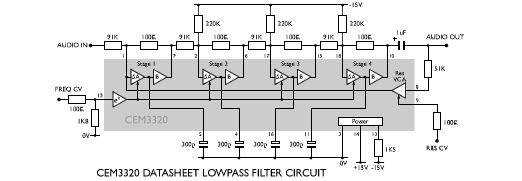
Like my SSM2044 page, this page is a look at how various synths implemented the CEM3320 filter, with the datasheet design as a reference standard. Whereas the SSM2044 is a dedicated lowpass filter, the CEM3320 is just a set of filter building blocks. In this respect, it is more like the earlier SSM2040. The CEM […]
Category: Vintage synths
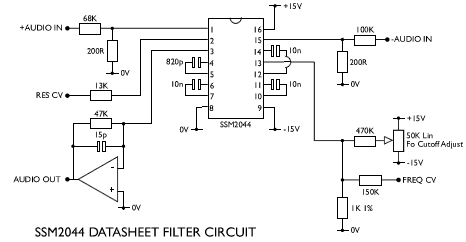
This page is a look at how various synths implemented the SSM2044 filter, with the datasheet design as a reference standard. I’ve redrawn all the schematics to make comparisons very easy. First, the datasheet design. The datasheet suggests using the two differential inputs (+audio and -audio) as individual oscillator inputs for a two-oscillator synth […]
This page is intended to be a look at some of the key technical aspects of the B3 Hammond organ that contribute to the “Hammond sound”. My personal slant is towards copying this sound using other technology. Perhaps one day I’ll build a “clonewheel” organ, but then again, Clavia might have nailed it! Still, building […]
I heard about this and could find little about it, so I started to investigate. Phase Distortion is one of those forgotten synthesis techniques that someone once built a few instruments with, and then abandoned. In the case of PD, Casio were unlikely synth pioneers to start with, and after a brief flirtation they gave […]
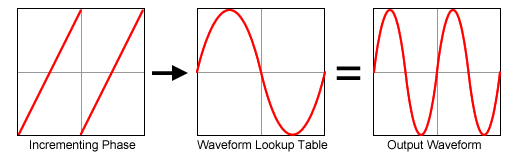
This page is an overview of two techniques for creating wavetable oscillators. Contents DDS – Korg DW series and similar Variable sample rate – PPG Wave and similar DDS – Korg DW series and similar The Korg DW series use a DDS oscillator scheme. Korg called it ‘DWGS’ for ‘Digital Waveform Generator System’ in the 80’s style […]
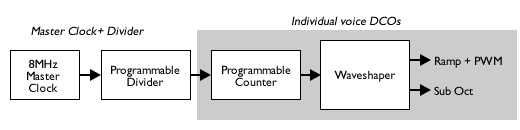
This page is a brief look at the technology of the Roland Juno series digitally controlled oscillators. The specific scheme presented here was introduced in the Juno 106 in 1984, but the same basic DCO design turned up in many Roland instruments through the 1980s (including the JX-3P, JX-8P, JX-10 and the MKS modules based […]