• Home
  • Shop
    • Oscillators
    • VCFs & VCAs
    • Envelope Generators
    • LFOs + Noise
    • Other synth parts
    • Stomp Boxes
  • Articles
    • Projects
    • Synth DIY
    • Stompbox stuff
    • Vintage synths
    • RC Filter Calculator
  • About Us
  • Contact
Skip to content
  • Home
  • Shop
    • Oscillators
    • VCFs & VCAs
    • Envelope Generators
    • LFOs + Noise
    • Other synth parts
    • Stomp Boxes
  • Articles
    • Projects
    • Synth DIY
    • Stompbox stuff
    • Vintage synths
    • RC Filter Calculator
  • About Us
  • Contact

Category: Vintage synths

Multimode filters, Part 2: Pole-mixing filters

Posted on May 24, 2020April 10, 2021

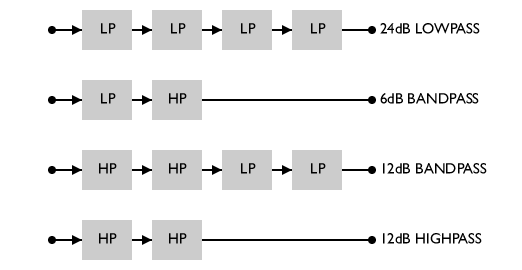
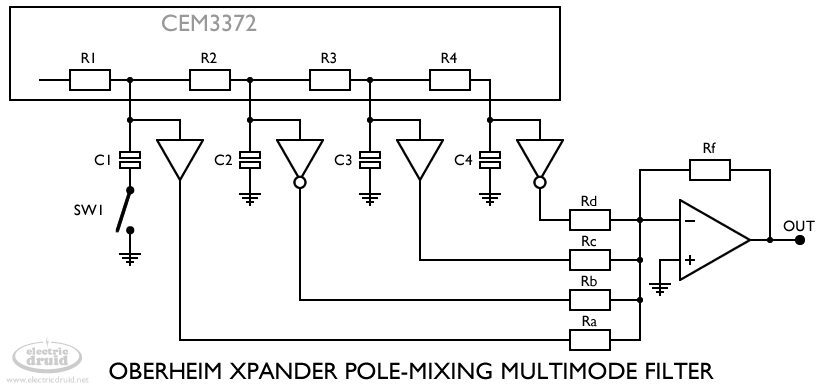
Last time we looked at reconfigurable filters, filters that include switches to rearrange parts of the circuit during normal use. However, that’s not the only way to produce different responses from a single filter circuit. This time, we’ll look at another approach: pole mixing. “Pole mixing”? It sounds like stirring a cake with a broom handle… […]
Posted in Filters, Matrix12, Oberheim, Synth DIY, Vintage synths, Xpander   25 Comments on Multimode filters, Part 2: Pole-mixing filters

A look at the TR-909’s noise generator

Posted on December 26, 2019January 11, 2020

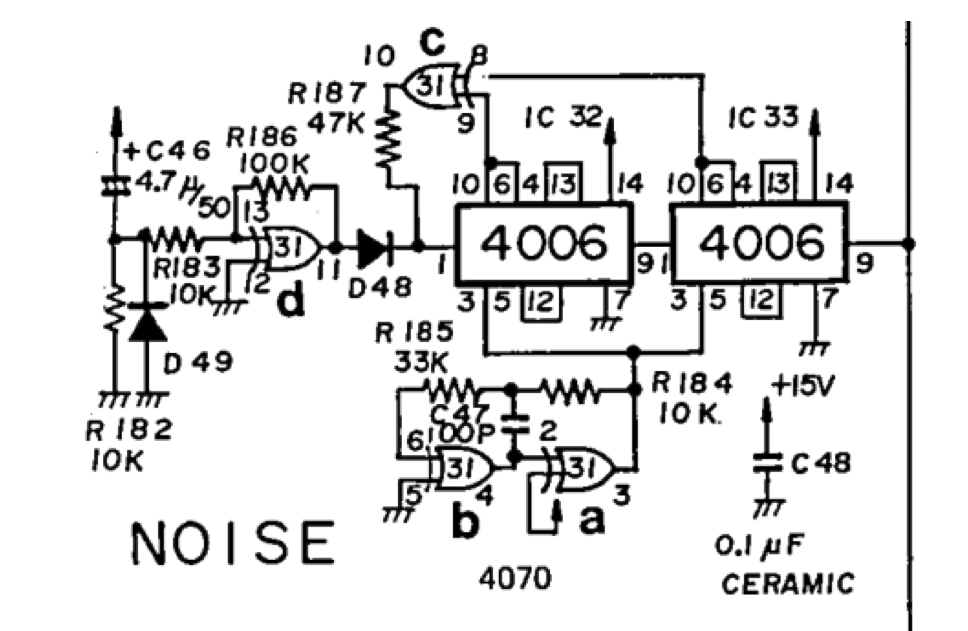
The TR-909 uses a hardware implementation of an LFSR as its noise generator. We’ve dealt with LFSR noise generators in a few other articles, but we’ve only looked at firmware implementations, so it might be fun to see how the same thing is done in hardware. The circuit is composed of three parts; the shift register […]

Posted in Noise, Roland, Synth DIY, TR-909, Vintage synths   4 Comments on A look at the TR-909’s noise generator

Roland “Cross Mod” and “Metal Sync” – What do they actually do?

Posted on August 27, 2019December 1, 2019

What do Roland’s “Cross Mod” or “Metal Sync” really do? There are quite few people asking this question on the internet, but no-one has much of an answer. Here’s a few forum discussions I found about it: https://www.harmonycentral.com/forum/forum/Keyboards/acapella-18/330134- http://forums.rolandclan.com/viewtopic.php?f=59&t=54410 https://music.stackexchange.com/questions/57210/what-exactly-is-the-cross-modulation-on-roland-jupiter-and-jx-analog-synthesiz/71048 Ok, so Harmony Central was never going to provide a solid technical answer, but the Roland Clan […]

Posted in GR-700, Jupiter 6, Jupiter 8, JX-10, JX-3P, JX-8P, MKS-30, MKS-70, MKS-80, Oscillators, Roland   12 Comments on Roland “Cross Mod” and “Metal Sync” – What do they actually do?

Experiments with variable rate drum sample playback

Posted on June 24, 2018February 18, 2019

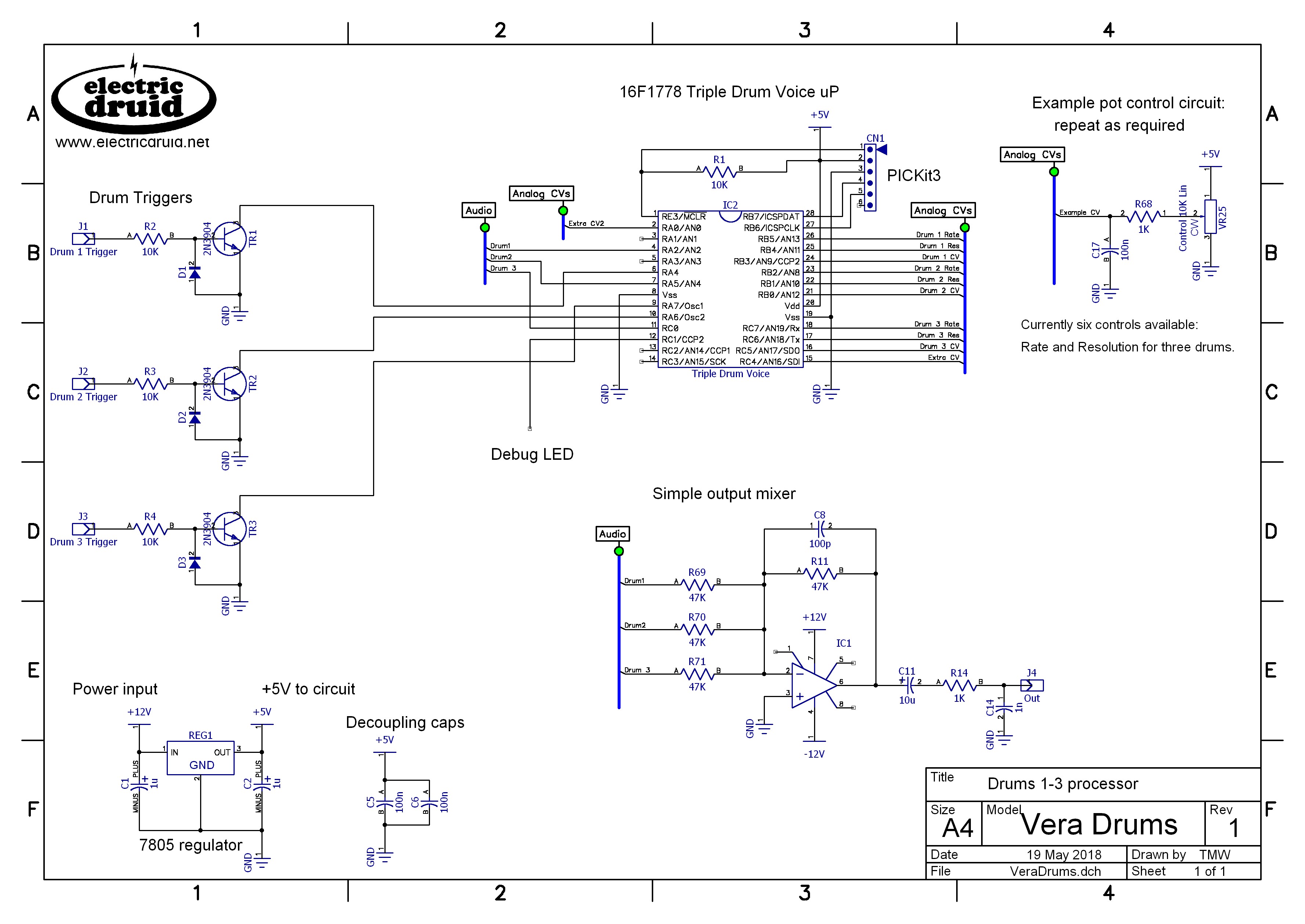
Or how to get a vintage 1980’s drum machine sound without selling your kidneys! There was a discussion on the SynthDIY mailing list recently about how the early digital drum machines like the LinnDrum or the Oberheim DMX used to change the pitch of drum sounds by simply changing the sample rate. They literally just […]

Posted in DMX, Linn, LinnDrum, Oberheim, Projects, Synth DIY, Vintage synths   21 Comments on Experiments with variable rate drum sample playback

Multimode filters, Part 1: Reconfigurable filters

Posted on June 6, 2017May 24, 2020

What is a “Multimode filter” anyway? It’s a filter which can provide more than one response. So it might offer a choice of 2-pole or 4-pole lowpass responses, or it might be switchable between lowpass and highpass, or it might have lowpass, bandpass, and highpass outputs. There are basically three techniques for building multimode filters, […]

Posted in Elka, Filters, OB-8, OB-Xa, Oberheim, Synth DIY, Synthex   11 Comments on Multimode filters, Part 1: Reconfigurable filters

A study of Sub-Oscillators (and Oscillator Waveshaping)

Posted on June 4, 2017January 7, 2020

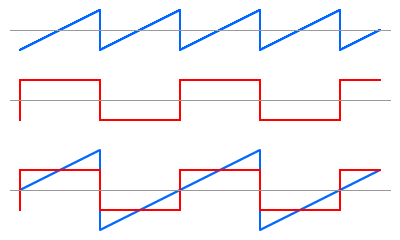
This article is a look at sub-oscillators, a common tactic for fattening up the bottom end, particularly  in synths with only one oscillator, or only one oscillator per voice. Classic examples include the Roland Juno 106 and SH101, and the Korg Polysix. More recently, sub-oscs turn up on a lot of modern analog synths since […]

Posted in Korg, Oscillators, Polysix, Roland, SH-101, Synth DIY, Vintage synths   18 Comments on A study of Sub-Oscillators (and Oscillator Waveshaping)

Adventures in Top Octave Generation

Posted on December 11, 2016January 22, 2019

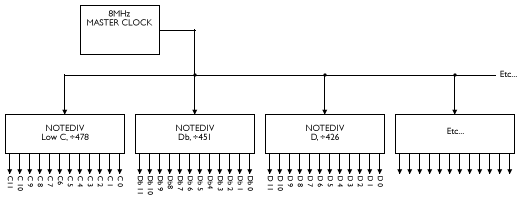
Can we make a modern reproduction of the classic top octave generator / top octave synthesiser chips of the 1970s, as used in classic string synths and combo organs? What would be involved? Can we improve on the originals in any way? This page is a summary of what I learned by doing it. A […]

Posted in Oscillators, Synth DIY, Vintage synths   27 Comments on Adventures in Top Octave Generation

Timbral Evolution: Harmonic analysis of classic synth sounds

Posted on August 30, 2016August 30, 2016

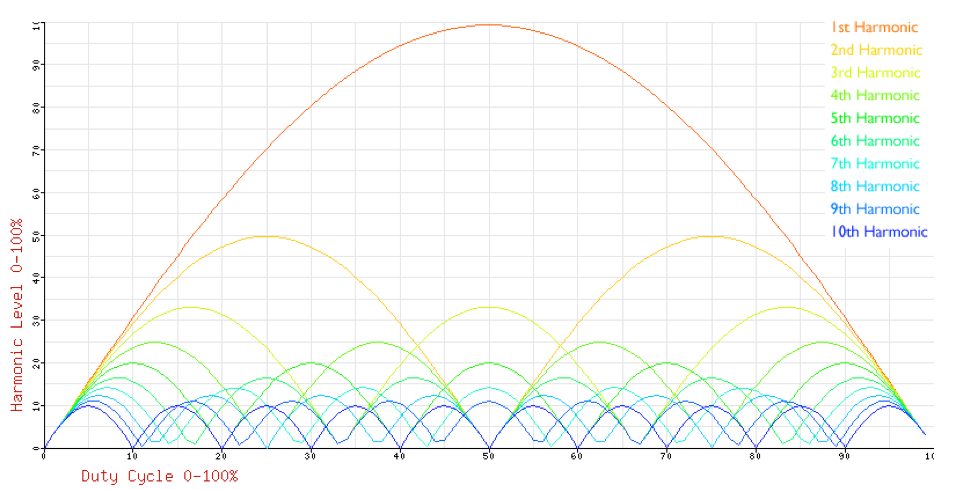
This post is a place to gather my thoughts about one of the most important parts of synthesizer design: the timbral evolution of sounds. It also presents the results of my analyses of some classic synth sounds. There have been many methods developed over the years to achieve timbral evolution. The voltage-controlled filter is the first […]

Posted in Phase Distortion, Synth DIY, Vintage synths   3 Comments on Timbral Evolution: Harmonic analysis of classic synth sounds

CEM3340 VCO (Voltage Controlled Oscillator) designs

Posted on August 27, 2016February 6, 2020

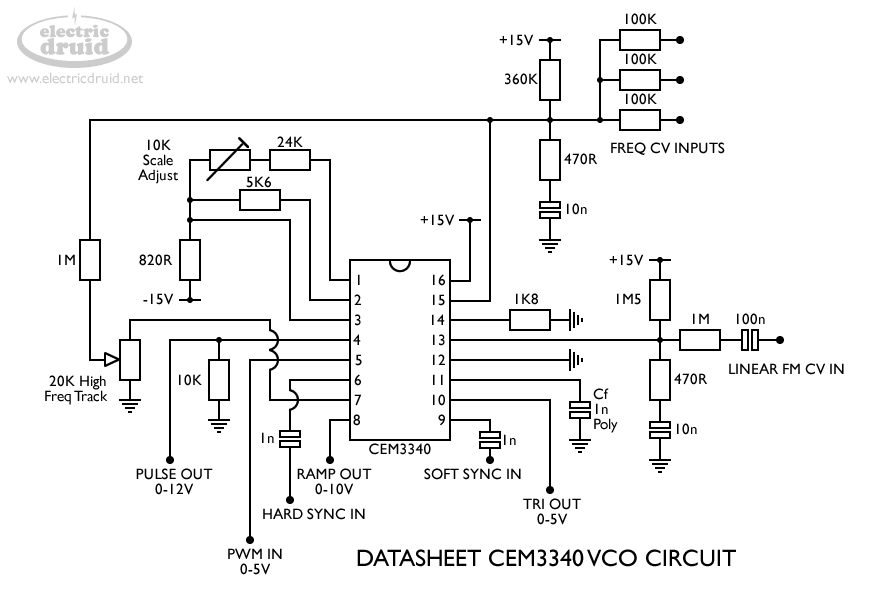
To celebrate the 2016 return of the CEM3340 chip, I thought I’d do another page in my series looking at how various synths implemented classic synth chips (the others being CEM3320 Filter designs and SSM2044 LP Filter designs). This is especially useful right now, since many people have bought a few CEM3340s or V3340s or AS3340s for their […]

Posted in Memorymoog, MKS-80, Moog, OB-Xa, Oberheim, Oscillators, Prophet 5, Prophet T8, Roland, Sequential, SH-101, Synth DIY, Vintage synths   53 Comments on CEM3340 VCO (Voltage Controlled Oscillator) designs

SH-101 replacement processor – a feasibility study

Posted on August 25, 2016August 26, 2016

The Roland SH-101 is a late-era analogue monosynth which uses a microprocessor to perform keyboard scanning and various related functions, much like the Sequential Pro-One. Since the original uP is a 40-pin DIP, it would be possible to replace it with a more modern 40-pin DIP uP, like the PIC 16F777, or with a modern […]

Posted in Roland, SH-101, Synth DIY, Vintage synths   9 Comments on SH-101 replacement processor – a feasibility study

Posts navigation

Older posts

Electric Druid

All Rights Reserved.

Comments & Feedback

If you’ve got comments, queries, or problems, please contact us. We’d love to hear your feedback about the site, our chips, and your ideas for new stuff!

Shipping

Read about our shipping policy here

Personal use

Druid code and schematics are released under a CC BY-NC-SA 4.0 license, so feel free to download and use Electric Druid code in your personal synth, pedal, or sonic blastertron 2000. Grab a copy of the schematics and tweak away to your heart’s content. If you don’t have a PIC programmer, you can order a chip from the shop. Check the legal stuff for more details.

Commercial use

Electric Druid code and schematics are released under a CC BY-NC-SA 4.0 license. Please check the legal stuff for more details. If you’d like to use Electric Druid chips, code, or circuits in your commercial product, we’d ask that you buy chips from us to help support the development of further projects. We can supply programmed, labelled chips in whatever quantities you need. If this isn’t suitable, please contact us to discuss your requirements. Thanks!