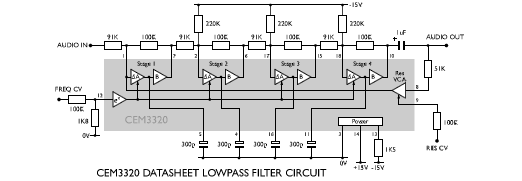
Like my SSM2044 page, this page is a look at how various synths implemented the CEM3320 filter, with the datasheet design as a reference standard. Whereas the SSM2044 is a dedicated lowpass filter, the CEM3320 is just a set of filter building blocks. In this respect, it is more like the earlier SSM2040. The CEM […]
Category: Synth DIY
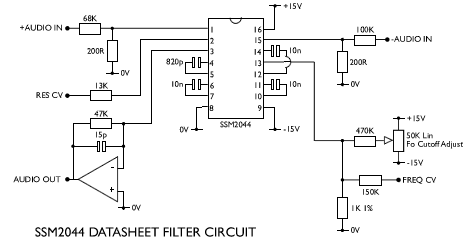
This page is a look at how various synths implemented the SSM2044 filter, with the datasheet design as a reference standard. I’ve redrawn all the schematics to make comparisons very easy. First, the datasheet design. The datasheet suggests using the two differential inputs (+audio and -audio) as individual oscillator inputs for a two-oscillator synth […]
This voltage-controlled LFO is based on the PIC 16F684, which is a pretty basic chip. Nonetheless, this LFO has more features than your average LFO. For a start, it can produce 7 basic waveforms, and also includes a noise source. It can also morph its waveforms under CV control, well beyond basic PWM. There is […]
Direct digital synthesis is a common technique for generating waveforms digitally. The principles of the technique are simple and widely applicable. You can build a DDS oscillator in hardware or in software. A DDS oscillator is sometimes also known as a Numerically-Controlled Oscillator (NCO). How does it work? The most important part of a DDS […]
This page is an overview of two techniques for creating wavetable oscillators. Contents DDS – Korg DW series and similar Variable sample rate – PPG Wave and similar DDS – Korg DW series and similar The Korg DW series use a DDS oscillator scheme. Korg called it ‘DWGS’ for ‘Digital Waveform Generator System’ in the 80’s style […]
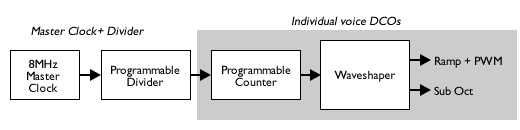
This page is a brief look at the technology of the Roland Juno series digitally controlled oscillators. The specific scheme presented here was introduced in the Juno 106 in 1984, but the same basic DCO design turned up in many Roland instruments through the 1980s (including the JX-3P, JX-8P, JX-10 and the MKS modules based […]