This post is a place to gather my thoughts about one of the most important parts of synthesizer design: the timbral evolution of sounds. It also presents the results of my analyses of some classic synth sounds. There have been many methods developed over the years to achieve timbral evolution. The voltage-controlled filter is the first […]
Articles
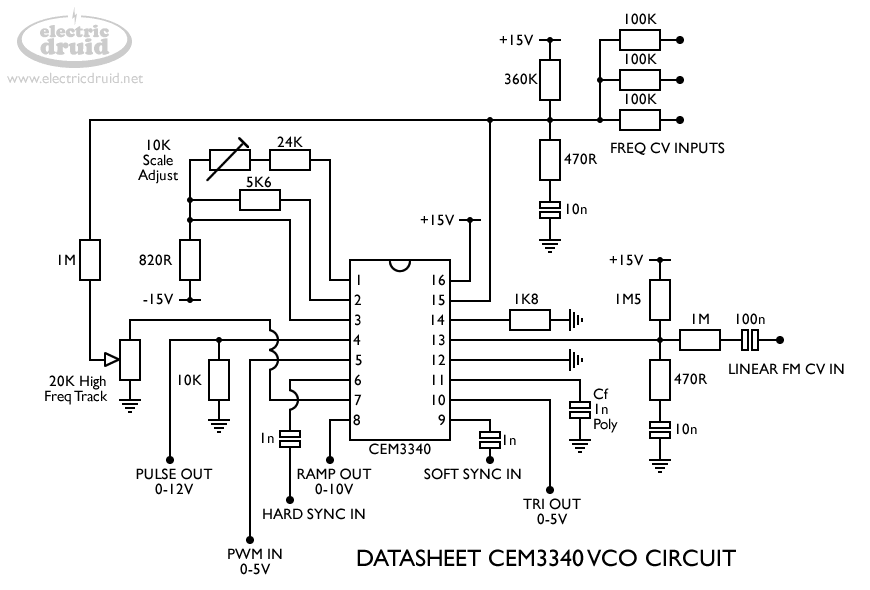
To celebrate the 2016 return of the CEM3340 chip, I thought I’d do another page in my series looking at how various synths implemented classic synth chips (the others being CEM3320 Filter designs and SSM2044 LP Filter designs). This is especially useful right now, since many people have bought a few CEM3340s or V3340s or AS3340s for their […]
The Roland SH-101 is a late-era analogue monosynth which uses a microprocessor to perform keyboard scanning and various related functions, much like the Sequential Pro-One. Since the original uP is a 40-pin DIP, it would be possible to replace it with a more modern 40-pin DIP uP, like the PIC 16F777, or with a modern […]
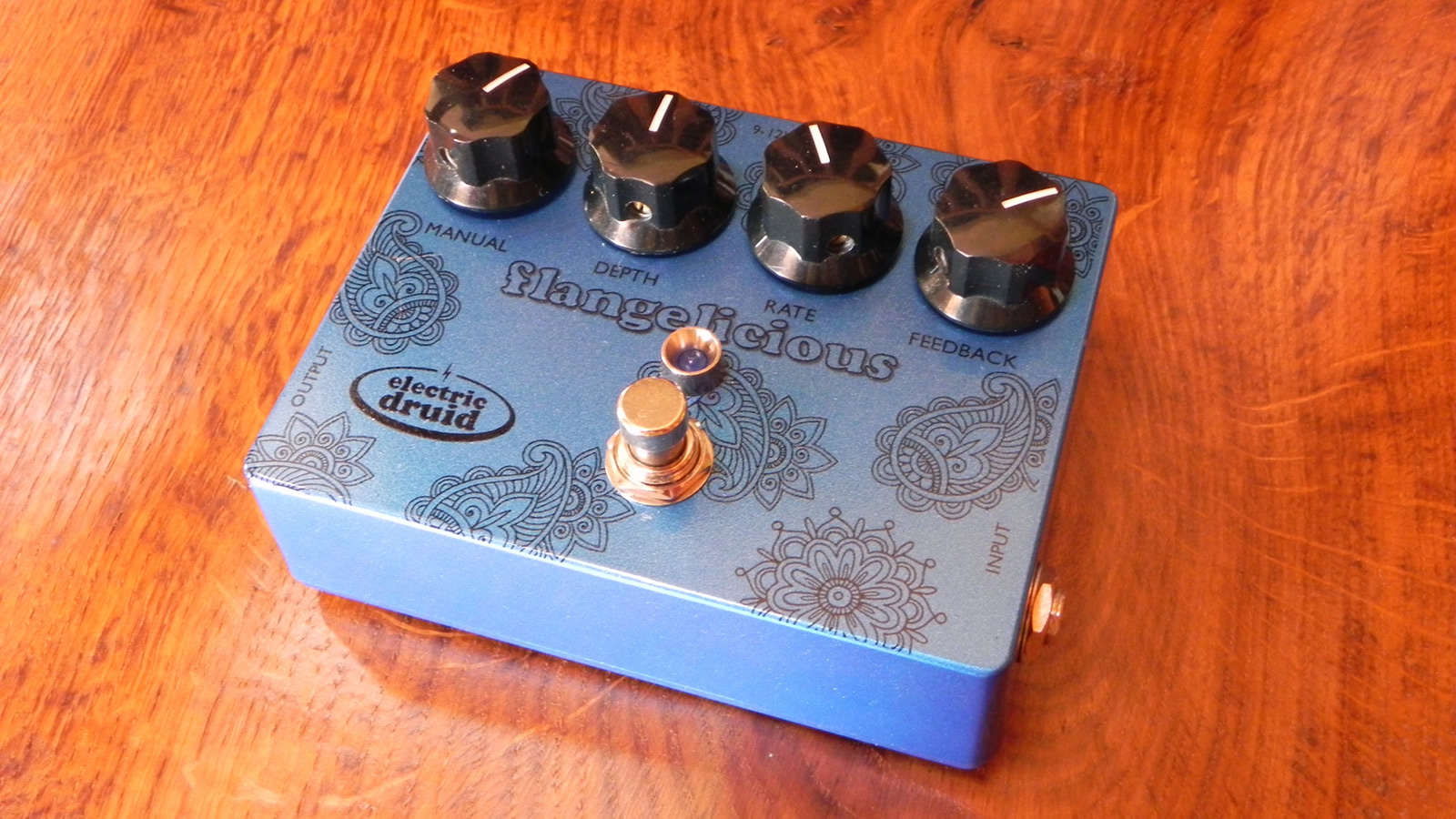
Flangers are generally regarded as one of the most complicated pedals to build. A typical design has tons of chips and lots of circuit elements. Flangelicious isn’t like that. By using a microprocessor to generate an LFO-modulated clock signal directly, we can get rid of a lot of the non-signal path stuff and add features whilst we’re about it. […]
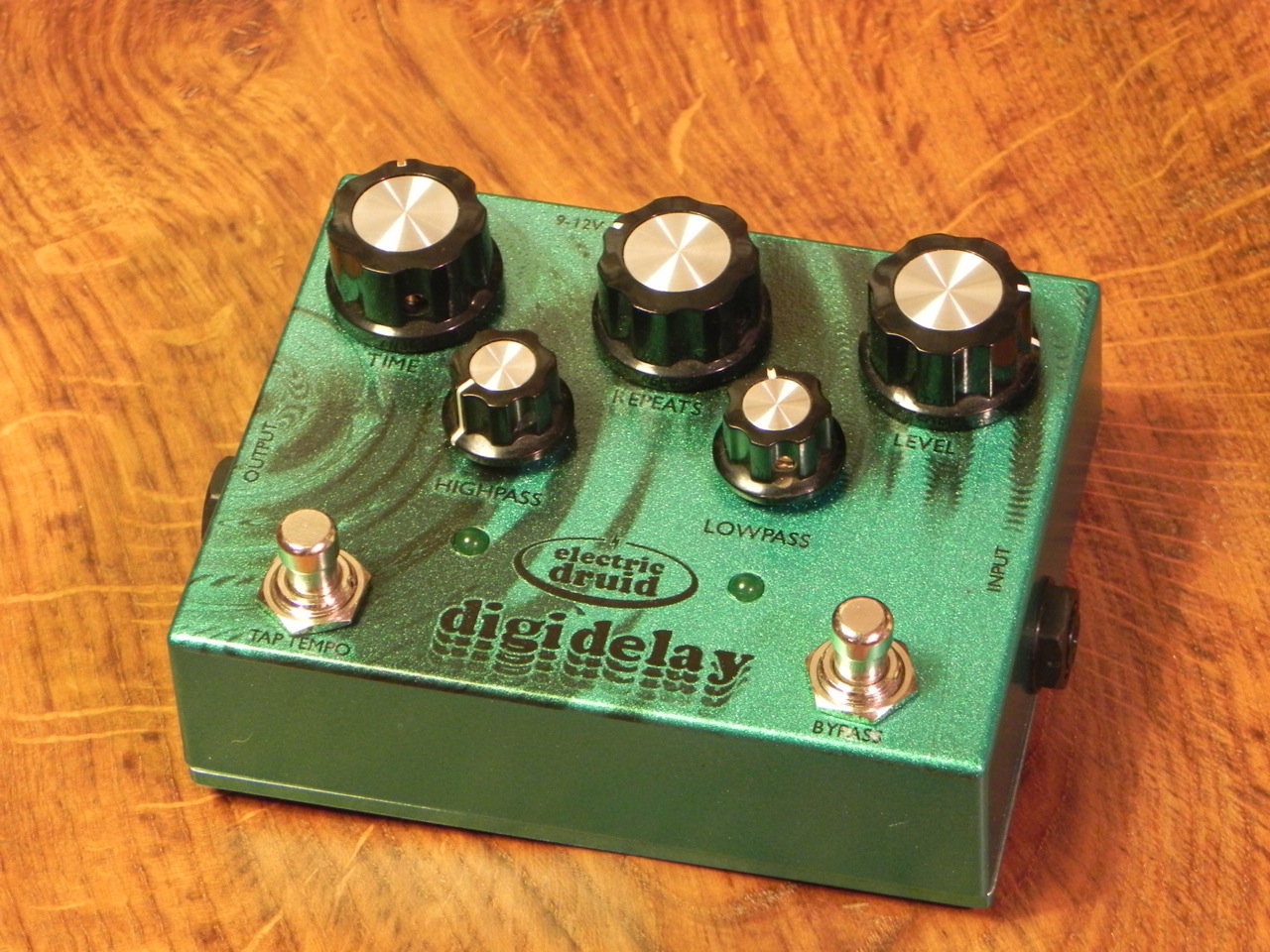
Recently I’ve been working on a four second digital delay with tap tempo and delay trails. There are lots of digital delay projects already, but the vast majority of them are based on the PT2399, which limits both the length of the delay and the sound quality. A quick summary of the features: 0 […]
The Boss MT-2 Metal Zone distortion pedal is one of the most complex drive pedals there is, and has probably the most sophisticated (and least understood!) tone control circuit on any mass-market pedal. It’s also quite a divisive beast, with some loving it, and others hating it. It’s a great pedal for modifications – easily available, […]
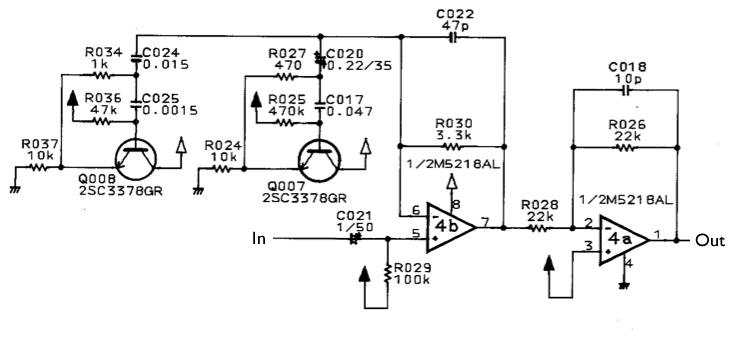
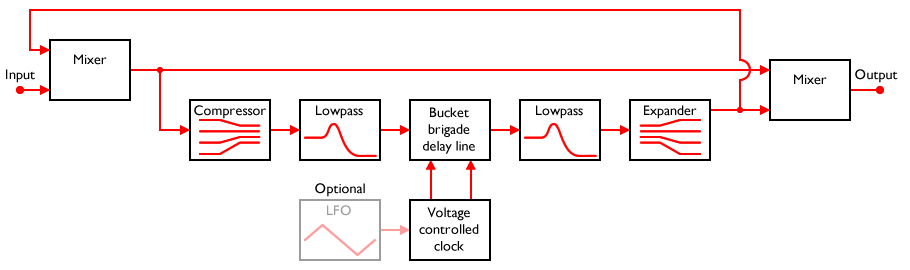
What’s a “compander”? It’s a simple way to make your circuit quieter! So how does it work? Let’s say we’ve got a fairly noisy effect, like a BBD. The basic idea is that you make quiet signals louder before you put them through the effect, and then you make them quiet again after the effect, […]
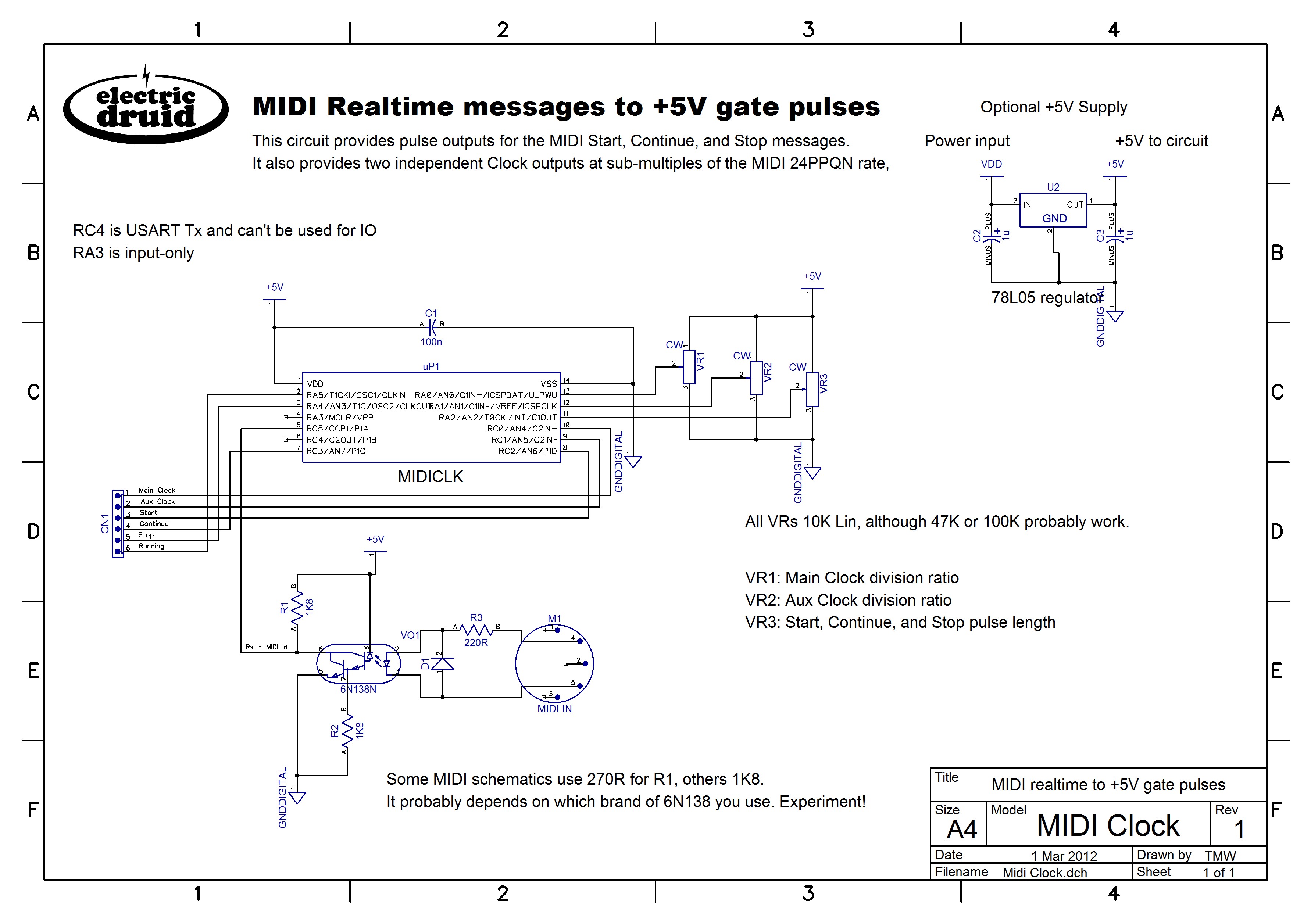
How do you synchronise your modular synth with MIDI equipment? MIDI provides the MIDI clock message, but you need something to convert this to a format an analog modular synth can understand. Most MIDI-to-CV convertors will do the job, but that can be expensive. Here’s a cheap way to do it. The Druid MIDICLK chip […]
I typically use the 12-bit MCP4822 DAC to produce a CV for the SSM2164 (or CoolAudio V2164, it’s the same thing) . This is a good, cheap combination. However, the 4822 produces an output of 0-4.095V, whereas the 2164 needs 0-3.3V. It is possible to use a simple voltage divider to reduce the voltage to […]
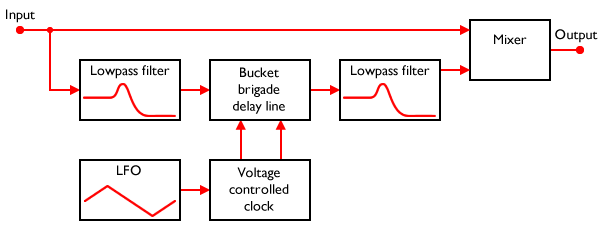
I’ve been curious about Chorus for a while, since I’ve been working on and off with chorus design myself. There were a few things I didn’t understand, like what the relationshp is between the modulation LFO’s waveshape and the frequency modulation of signals going through the chorus. You’d think that if you use a sinewave […]